


Guilhem MOLLON
guilhem.mollon@insa-lyon.fr
Associate Professor
National Institute for Applied Sciences of Lyon
PhD, Civil Engineering, INSA Lyon
HDR, INSA Lyon
Guilhem MOLLON
guilhem.mollon@insa-lyon.fr
Associate Professor
National Institute for Applied Sciences of Lyon
PhD, Civil Engineering, INSA Lyon
HDR, INSA Lyon
Numerical simulation at small scale of conventional granular materials by the Discrete Element Method has now become a well-established technique. For the very soft granular materials, however, studies are rarer because numerical tools allowing such simulations are not common. In this work, we use the code MELODY, based on a multibody meshfree approach, to simulate granular samples with grains that are very soft with respect to the applied loads.
This code is used to perform a detailled study of the mechanical behavior of mixtures of soft and hard grains submitted to shearing. Simulations show a wide variety of behaviors, both quantitatively (peak strength, dilatancy, secant stiffness, etc.) and qualitatively (plastic flow regimes, force chains, etc.). This study paves the way to deeper analyses of this rather unstudied class of materials.
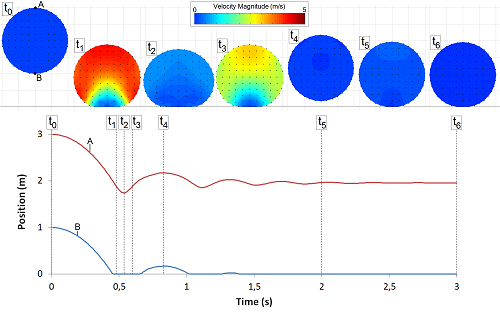
Figure 1. A soft body bouncing on a rigid substrate, modelled by MELODY.

Figure 2. Pile of soft grains with arbitrary shapes under gravity, and associated shear stress field.
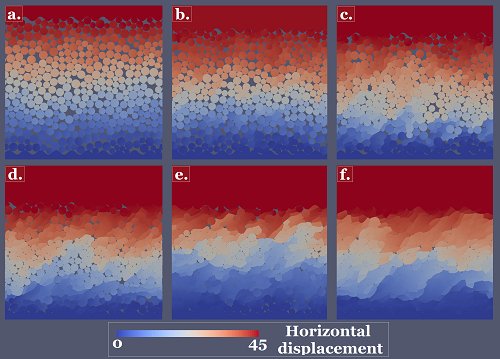
Figure 5. Final state of the six simulations, emphasizing the different plastic flow regimes.
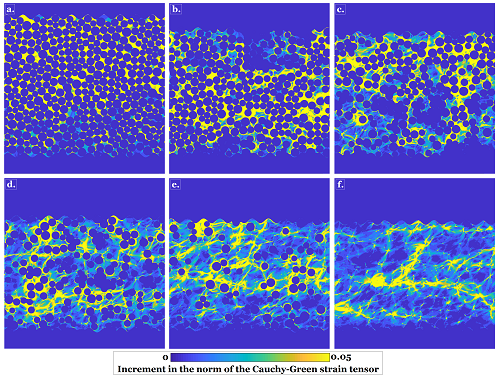
Figure 7. Different plastic flow regimes as evidenced by fields of local shear strain rate.

Figure 3. Two classes of bodies (hard and soft) which can be introduced in MELODY.
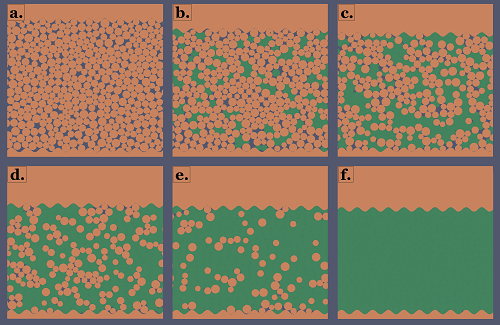
Figure 4. Initial states after frictionless compaction for six simulations of direct shear, with an increasing proportion of soft grains.
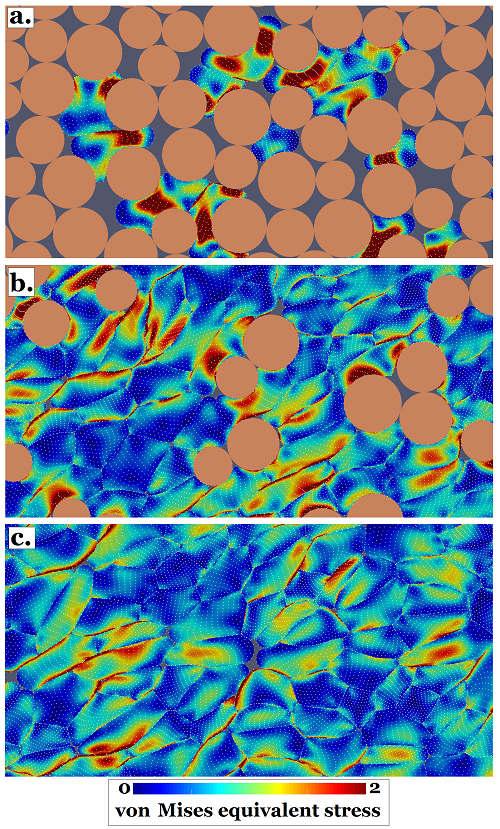
Figure 6. Stress fields within soft grains during simulations. stress concentrations at the neighbourhood of rigid grains clearly appear.